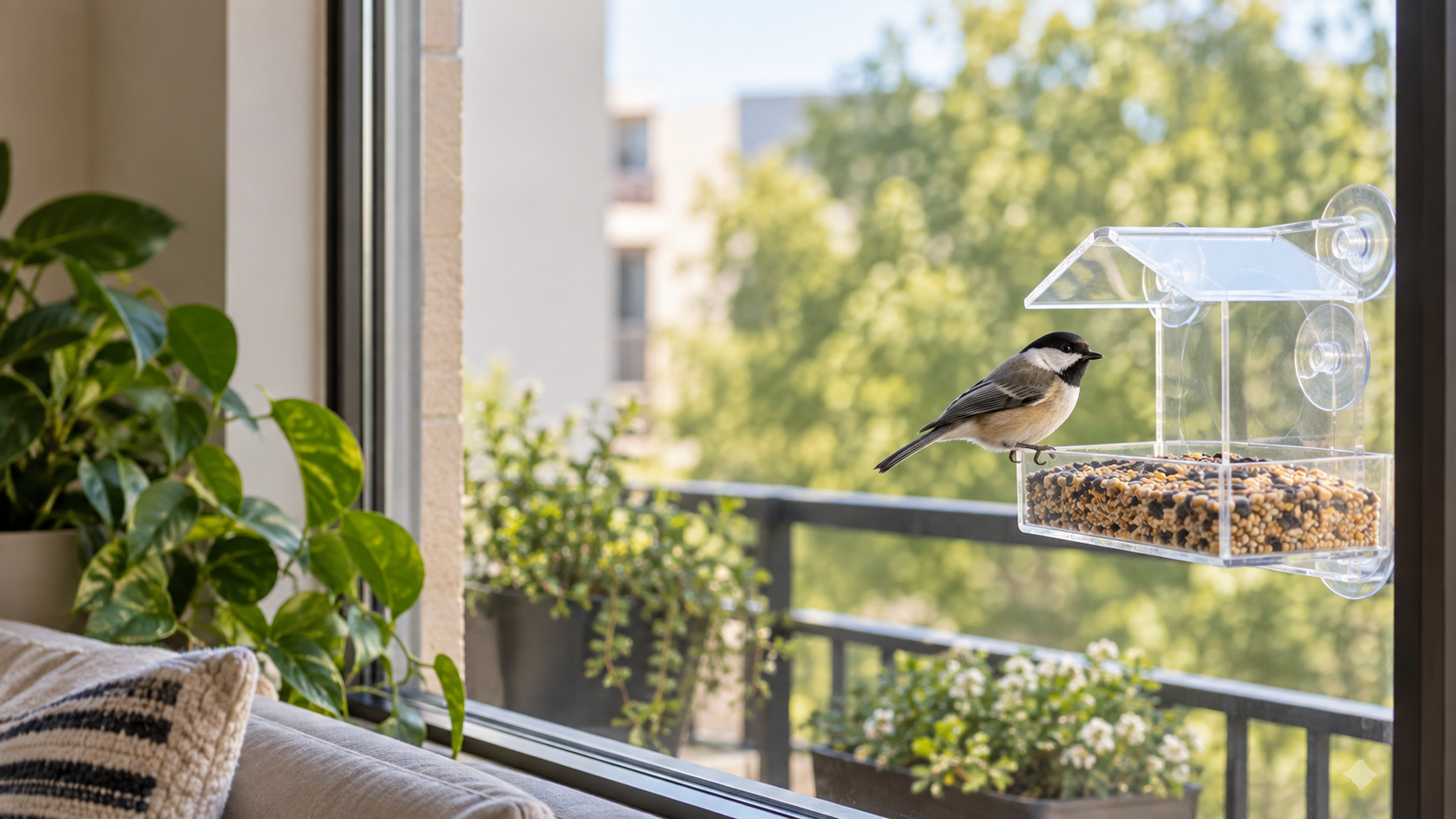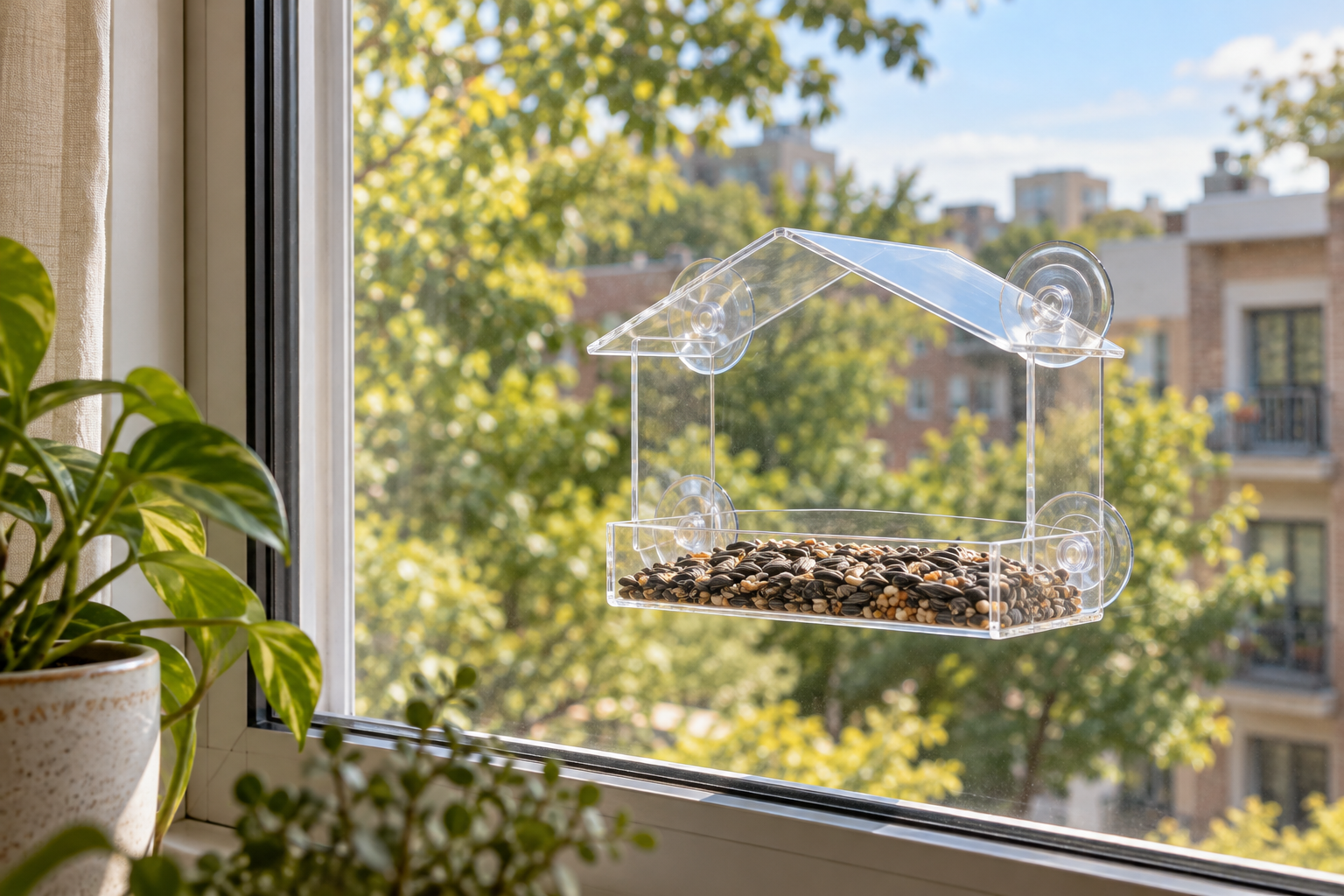
A window feeder can be installed correctly and still receive no visitors at first. Birds need to discover it, and an apartment’s surroundings can influence whether they approach.
Before buying another feeder, check the setup you already have. The following checks can help you identify practical changes without adding more equipment or seed.
Check whether birds are active nearby
Watch the area around your apartment. Do you see birds visiting nearby trees, shrubs, balconies, or other feeders?
Cornell Lab of Ornithology explains that nearby habitat can influence how readily birds discover an apartment feeding area. Trees and other vegetation around the building may help, but visits are never guaranteed.
A window high above a busy street may offer different opportunities from one overlooking trees. If you rarely see birds nearby, changing the feeder alone may not solve the problem.
For more context, see Cornell’s guidance on attracting birds to a high-rise apartment.
Inspect the feeder’s position and mounting
Check that the feeder is securely installed according to the manufacturer’s instructions. Make sure its entrance and perches are accessible and that a fixed insect screen does not prevent proper mounting.
Inspect the setup after wind or rain. A loose feeder, wet tray, or exposed position needs attention before you continue feeding.
Choose a location you can reach safely for cleaning and refilling. Never lean out of a window or over a balcony railing to adjust it.
Review window safety before moving it
Moving a feeder farther away from the glass is not automatically safer. Cornell recommends placing feeders directly on the glass or within 3 feet of a window to reduce the speed of a potential collision.
Close placement does not eliminate every risk. Review the surrounding glass as well, and take action if birds strike the window. Pause feeding while you address the problem.
See Cornell’s guidance on feeder placement and window safety before changing the location.
Check the seed instead of adding more
Inspect the food already in the tray. Remove seed that is wet, clumped, moldy, or spoiled. Empty and clean the tray rather than covering old seed with a fresh layer.
Check whether the seed is suitable for birds commonly seen in your area and compatible with your feeder. Adding a larger amount does not resolve unsuitable food or a poor location.
Start with a small portion so you can monitor its condition and avoid waste. For considerations about shells and cleanup, see Best Bird Seed for Apartment Balconies: Low-Mess Choices and What to Avoid.
Keep seed contained in the feeder. Scattering it from an apartment window can affect neighbors and shared spaces.
Observe what happens near the glass
If birds approach but leave before feeding, note what happens at that moment. Are you opening the window, walking up to the glass, or allowing a pet to watch immediately beside the feeder?
As a practical observation test, watch from farther inside the room and avoid approaching the glass when birds arrive. Record whether their behavior changes rather than assuming indoor activity is the cause.
Keep the window closed while birds are using the feeder.
Give a safe setup time to be discovered
Cornell notes that birds may need time to find a new feeding station. There is no fixed waiting period that guarantees visits.
Once you have checked safety, mounting, and food condition, avoid moving the feeder every day. Observe it at different times and keep a brief record of visits.
Change one thing at a time when an adjustment is needed. This makes it easier to understand what helped. Correct safety problems immediately rather than waiting.
Check access before replacing the feeder
A different feeder may help if your current one does not fit the glass, cannot be mounted securely, or is difficult to empty and clean. A larger feeder, however, does not guarantee more birds.
If you need to compare dimensions and removable tray designs, see Best Window Bird Feeders for Apartments and Small Spaces.
Choose equipment for a specific need you have identified, and check building rules before changing the setup.
A simple observation checklist
- Look for bird activity around the building.
- Inspect the mounting, perches, and tray.
- Review the surrounding window for collision risks.
- Remove wet or spoiled seed.
- Observe from farther inside the room.
- Record visits and adjust one thing at a time.
Final thoughts
An empty window feeder does not necessarily mean you chose the wrong product. Nearby habitat, food condition, placement, and the time needed for discovery can all matter.
Start by checking the setup you have. Keep it safe, clean, and manageable, and use your observations to decide what to change. Some apartment windows may receive few visits even with a carefully maintained feeder.